
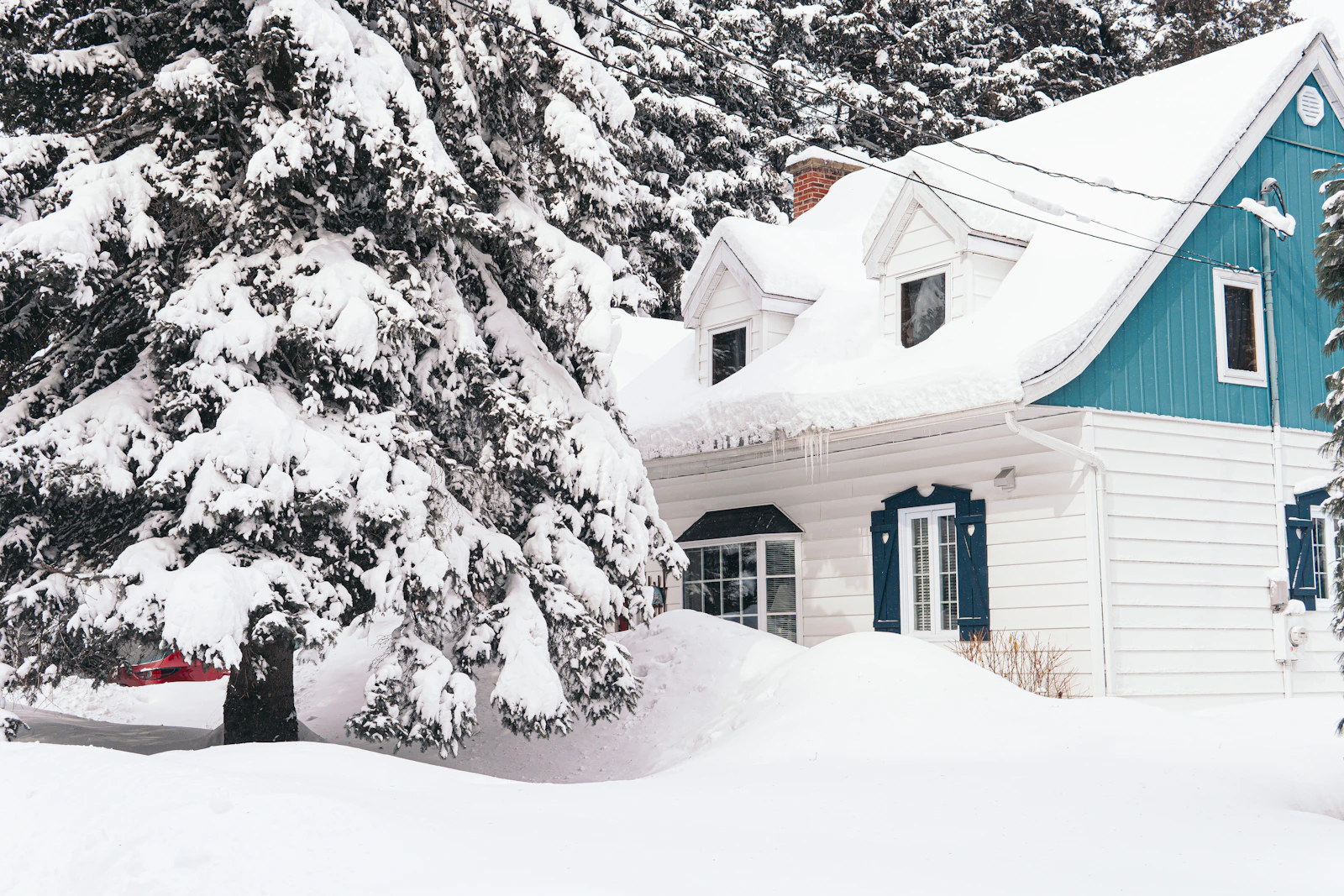
Why do ice dams form?
Ice dams form when snow on a roof melts, runs down to the colder eaves and refreezes. Heat escaping from the house warms the roof above living spaces, while the overhangs stay cold. Sunny days and cold nights, common in the valley, speed up the cycle.
Over time, the ice builds a ridge at the edge of the roof. Melt water backs up behind it and can work under shingles and into walls and ceilings. Large icicles also form, which are a danger over doors, decks and walkways.
Does heat tape fix ice dams?
Heat cable manages the symptom. It creates warm paths through the ice so water can drain. The underlying causes are often heat loss and poor ventilation in the attic or roof assembly. Improving insulation, air sealing and ventilation can reduce ice dams, and in some homes that is the better long-term fix. Many mountain homes, especially with complex rooflines, benefit from both.
A roofer or energy auditor can help with the building side. An electrician handles the heat cable, the circuits and the controls.
Where does heat cable go?
Placement matters more than the amount of cable. The goal is a continuous path for water from the roof, through the gutter and down the downspout to the ground.
- Along roof edges and overhangs in a pattern that reaches above the area where ice forms
- In roof valleys, where snow and water concentrate
- Inside gutters, to keep them from freezing solid
- Inside downspouts, all the way to the outlet, so water does not refreeze at the bottom
- Over entries and walkways where icicles are a safety concern
What kind of cable should you use?
Self-regulating cable is the common choice for roofs and gutters. Its output adjusts with temperature, producing more heat where it is cold and less where it is warmer, and it can be safely overlapped where constant-wattage cable cannot. Use cable and mounting clips listed for roof and gutter de-icing and suited to your roofing material.
Pipe freeze protection uses its own cable, designed for pipes and installed according to the manufacturer. Roof cable and pipe cable are not interchangeable.
How should heat tape be wired?
Heat cable is a real electrical load and it runs outdoors in wet conditions. Electrical code requires ground-fault equipment protection for de-icing and snowmelting cable, which shuts the circuit off if current leaks to ground.
Many older installations are simply plugged into exterior outlets. That often overloads circuits that were never sized for long runs of cable, leaves cable unprotected and makes it hard to tell when something has failed. A properly installed system uses a dedicated circuit sized for the cable, the required ground-fault protection and connections rated for outdoor use.
How do you control heat tape?
Running cable all winter, day and night, uses power when it is not needed. Controls fix that. A simple switch or timer is better than nothing. A thermostat turns cable on only when it is cold enough to matter. A snow and moisture sensor turns it on only when there is both cold and moisture, which is when ice forms. Some controllers can be monitored remotely, useful for second homes. With self-regulating cable and a good controller, the system runs when conditions call for it.
When should you install or check heat tape?
Early fall, before the first hard freeze. Roofs are dry and safe to work on, and the system is ready when snow arrives. Installing in midwinter is possible but slower and riskier, and by then ice may have already done damage.
If you already have heat cable, test it each fall. Look for physical damage, check that controllers and indicator lights work, and confirm the circuit is not tripping. Cable that stays cold or trips its protection needs to be tested and repaired or replaced before winter.